
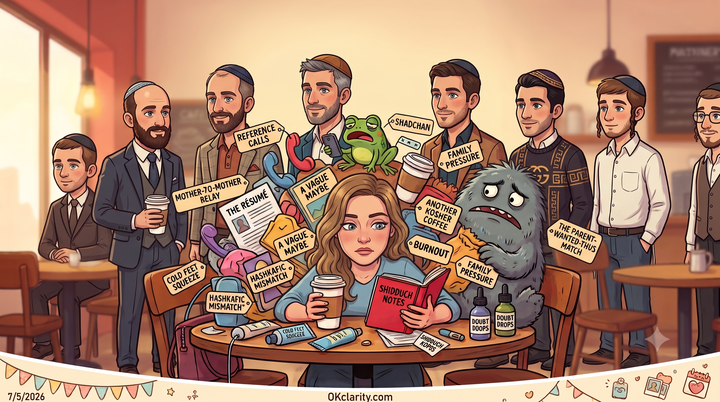
Shidduchim and Dating: The Emotional Side:
Most shidduchim advice tells you how to date. Almost none of it tells you how to stay okay while you do. This is for the single who is still in it, or the parent, sibling, or friend standing next to them, and it takes the emotional weight seriously instead of pretending a good hashkafic match cancels it out. Shidduchim and dating can be efficient and warm and completely draining, sometimes in the same week. Everything below assumes you already know that.
A note before we start. When the hard feelings tip into something that doesn't lift, that's not a character flaw or a lack of bitachon. It's a signal, and there are people trained to help with exactly this.
Cold feet or a real reason to stop
Here is the cleanest test I know. Cold feet points at the decision. A red flag points at the person.
Cold feet is the fear of finality. It tends to spike before a date and settle once you're actually sitting across from someone. It shows up with every good option, because the thing you're scared of isn't this person, it's choosing, and closing the door on everyone else. It's fuzzy. You can't name what's wrong, only that something feels heavy. A red flag is specific and it repeats. It's a pattern in how he talks about his mother, or how she treats the waiter, or the third time a story didn't add up. More information makes cold feet quieter and a real red flag louder. That's the tell. Sit with the doubt for a few days. If you can't put words to it and it fades when you're with the person, it's probably nerves. If you keep explaining it away to other people, it's probably not.
There's a middle case nobody warns you about: the match that's fine on paper and flat in the room. That isn't a red flag. It also isn't a reason to force a fifth date because the references were glowing. "Fine" is allowed to be a no.
When you're just done
Dating burnout is real, and in shidduchim it has a particular shape. You're not tired of one bad date. You're tired of the machinery. The reference calls, the mother-to-mother relay, the résumé that is somehow you and not you at all. People hit a wall where they stop being able to tell a promising suggestion from a dead end, because every suggestion now lands the same way: as one more thing to manage.
That flatness has a name. When you stop caring about outcomes you used to want, when a yes and a no feel identical, that's closer to depletion than to picky. Real burnout dulls your judgment, so pushing through it usually produces worse dating, not more of it.
So take the break. A month off the parsha will not cost you your bashert. It might be the thing that lets you show up as a person again instead of a candidate. And if the flatness doesn't lift when the pressure comes off, if it follows you into the rest of your life, that's worth saying out loud to someone who can help. Burnout lifts with rest. Depression doesn't.
Dating with an anxious mind, and the disclosure question
This one gets its own long stretch, because it's the one people carry the most shame about and get the least honest guidance on.
Anxiety is not rare, and neither is dating with it. The National Institute of Mental Health puts the lifetime prevalence of any anxiety disorder among U.S. adults at 31.1 percent, and OCD at 2.3 percent. Read that again. Roughly one in three people will meet criteria for an anxiety disorder at some point. The person across the table has a real chance of understanding more than you'd guess, because odds are they've met it in themselves or someone they love.
Dating with anxiety, OCD, or a trauma history brings a few specific hard parts. Anxiety can masquerade as a red flag, that cold-feet dread turned up loud, so you second-guess a good person because your body is buzzing. OCD can attach itself to the relationship directly, a loop of "but am I sure" that no amount of certainty quiets, sometimes called relationship OCD. Trauma can make normal closeness feel unsafe in ways that have nothing to do with the person in front of you. None of these mean you can't date well. They mean the noise in your own head is a separate channel from the information about the match, and part of the work is learning to tell them apart. A therapist is genuinely useful here, not because you're broken, but because an outside read on which signal is which is hard to do alone at 1 a.m.
Then the question everyone actually wants answered: what do you disclose, and when?
Start with what disclosure is not. It is not a confession, and it is not a warning label. A managed condition is a piece of your life, like anything else you'd share as two people get closer. The research on timing is reassuring, and it cuts against the instinct to hide. Studies on disclosing mental illness to a partner find that early, fuller openness tends to build closeness, while late and partial disclosure produces more negative reactions, the sense of having been kept in the dark. Writing in Psychology Today in 2025, clinicians describe the workable window as the point where the relationship has matured enough to feel safe, often around the exclusivity mark, rather than months later when a partner can feel misled.
In practice, for shidduchim, that means a few things. You don't owe your diagnosis to a first date or a shadchan. What's stable and managed is yours to share on your timeline, as trust builds. What actively shapes a shared life, and what a spouse would reasonably need to plan around, belongs on the table before an engagement, not after. The frame that helps: you're not asking permission to have a condition. You're giving someone the information they need to choose the relationship with their eyes open, the same courtesy you'd want. Someone who walks because you manage anxiety with a therapist and a plan told you something useful early. Better now than under the chuppah.
If disclosure in the frum world feels higher-stakes because of "what people will say," that fear is not imaginary, and it's also not the whole story. Discretion is your right. A good therapist, and increasingly a matchmaker who gets it, can help you decide what's genuinely relevant to share versus what's yours to keep.
The older single problem nobody names well
Being single past the age your community expects is its own kind of hard, separate from the dating itself. The weddings. The kiddush questions. The younger sibling whose engagement quietly reshuffles the family. In a world organized around marriage and building a home, staying single can feel like standing still while everyone moves past you, and that ache is real even when your life is full.
Two things can be true at once. The pain is legitimate, and the story your mind tells about it is often wrong. "Older single" is a community label, not a verdict on your worth or a prediction about your future. Plenty of people marry at ages the shidduch system treats as late, and build homes as warm as anyone's. What erodes people isn't usually the being-single. It's the being-watched, the sense of a clock everyone else is reading out loud.
You can push back on that without leaving your community. Curate who gets to ask you about it. Build a life that is good now, not a waiting room for the life that starts at marriage. And when the low days stretch into low weeks, when the self-talk turns from "this is hard" to "something is wrong with me," that's the point to bring in help. The label is the community's. Your inner life doesn't have to run on it.
Managing the shadchan without torching the relationship
A shadchan is doing you a favor and running a numbers game, both at once, and most friction comes from forgetting one of those halves. You're allowed to have boundaries. You just have to hold them like a mensch.
A few that tend to work:
- Be reachable but not on call. "I usually respond within a day or two" is a boundary, not rudeness.
- Give real feedback, not a lecture. "Not for me, the values weren't a match" beats a paragraph dissecting the poor guy.
- Say no to redt suggestions clearly and kindly. A vague maybe wastes everyone's time and makes you harder to help.
- You don't owe a play-by-play of every date. "It didn't work out, thank you for thinking of me" is complete.
The relationship survives on respect, not availability. A shadchan who feels appreciated and gets clean, honest feedback will keep you in mind. One who feels managed like a vendor, or strung along, quietly stops calling. If a particular shadchan pushes past your no or pressures you, you can step back from that one specifically without blowing up your reputation. Warmth and firmness are not opposites here.
When your parents want one thing and you want another
You and your parents disagree about a shidduch. This is one of the most painful binds in dating, because both sides usually love you and both sides think they're protecting you.
Separate the what from the why. Your parents' actual concern, money, family background, a specific worry about the person, is worth hearing even when they land somewhere wrong, because sometimes they see a pattern you're too close to see. But the decision about whom you marry is yours to make and yours to live inside. That's not disrespect. It's the plain reality of who wakes up in the marriage.
The move that lowers the heat is curiosity before defense. "Tell me what worries you" gets you further than "you don't understand." Sometimes their objection is concrete and fixable. Sometimes it's a bias they can't fully defend once it's said out loud. And sometimes you'll go ahead over their reservations, or let a match go because their read finally landed. When the conflict is stuck and painful, a neutral third party, a rav, a mentor, a family therapist, can hold both sides better than the two of you can at the kitchen table. Bringing in help isn't going around your parents. It's refusing to let the disagreement cost you the relationship.
After a broken engagement
A broken engagement is a divorce that history pretends didn't happen, and that's most of why it's so isolating. You grieved a marriage. You lost a future you'd already started decorating. And the community often has no ritual for it, so you're expected to bounce back to dating as if you misplaced a set of dishes.
Give it the weight of a real loss, because it is one. The grief is not proportional to how long the engagement lasted. What breaks isn't just the relationship. It's your trust in your own judgment, the plans, sometimes your standing in a community that talks. People rush back to the parsha to prove they're fine, and rushing is usually how you carry the last one straight into the next.
Getting yourself back looks slow and unglamorous. It's reconnecting with who you were before the engagement swallowed your calendar. It's the ordinary work of trusting your read again, one small decision at a time. And it very often means talking to someone trained in loss, because a broken engagement sits in a gap the community leaves open, and a good therapist can hold what the machinery around you skips over. There is no timeline you owe anyone. The next chapter starts when you're ready, not when someone decides you've mourned long enough.
If someone you love is in the parsha
Watching a sibling or friend go through shidduchim while you have no control over the outcome is its own quiet helplessness, and it's easy to make it worse while trying to help.
The instinct is to fix. To send suggestions, to ask for updates, to cheerlead. Most of it, however warm, lands as pressure, because it reminds the person that everyone is watching the scoreboard. So ask before you advise. "Do you want to talk about it, or do you want a break from the topic?" is one of the kindest sentences you can offer someone in dating, and almost nobody does. Be the person they can sit with without the subject coming up. Don't relay their status to the family network. Don't ask "so, any news?" at every simcha. And if you're genuinely worried, that they've gone dark, that the light's gone out of them, say the worried thing gently and directly, rather than pushing another redt. Presence beats advice here, most of the time. The best support in shidduchim is often the friend who makes the rest of life feel normal.
A short glossary for anyone new to this
Shidduch dating has a vocabulary of its own, and half the stress of standing near it is not knowing the words. A quick set:
Shidduch (plural shidduchim): a match for marriage; also the whole system of arranged introductions. "Being in shidduchim" means actively dating to marry.
Shadchan (plural shadchanim): the matchmaker who suggests and coordinates matches.
Redt: to suggest a match. A shidduch that's been "redt" has been proposed.
The parsha: shorthand for the dating scene. "In the parsha" means actively dating.
Bashert: one's destined spouse; the person you're meant to marry.
Reference calls: the vetting phase, where families call people who know the other side before a first date.
Older single: a community label for someone dating past the age their circle treats as typical. A description of timing, not worth.
Tenaim / vort / l'chaim: engagement milestones. A broken engagement can mean these were made and then ended.
Frum: religiously observant.
Hashkafa: religious outlook and values; a common axis of matching.
Shomer (negiah): observing the practice of not touching before marriage, which shapes how frum couples date.
Where this leaves you
Shidduchim and dating asks you to stay open and stay yourself while a whole system processes you, and that's a lot to hold. Take the parts that fit, leave the parts that don't. The hard feelings are not evidence that you're doing it wrong. They're evidence that it's hard.
And when the weight is more than a good week can fix, when the burnout won't lift, the anxiety runs the show, or a loss sits too heavy, that's not the moment to white-knuckle it.
OKclarity.com features hundreds of Jewish therapists, dating coaches, and other professionals who work with the Jewish community and understand this exact world, which makes finding someone who gets it a lot less lonely.
Getting help isn't stepping out of the process. Sometimes it's the thing that lets you stay in it as yourself.
References
- National Institute of Mental Health, “Any Anxiety Disorder,” statistics page. https://www.nimh.nih.gov/health/statistics/any-anxiety-disorder
- National Institute of Mental Health, “Obsessive-Compulsive Disorder (OCD),” statistics page. https://www.nimh.nih.gov/health/statistics/obsessive-compulsive-disorder-ocd
- Psychology Today, “When and How to Share Your Mental Health History in Dating,” 2025. https://www.psychologytoday.com/us/blog/divergent-minds/202511/when-and-how-to-share-your-mental-health-history-in-dating
- Taniguchi-Dorios et al., disclosure and relational closeness study, 2023 (Journal of Community & Applied Social Psychology). https://onlinelibrary.wiley.com/doi/10.1002/casp.2739
- OKclarity, Jewish mental health and wellness directory. https://okclarity.com/
Comments (0)
Add Comment
Login to join the discussion