
Is Therapy Permissible in Judaism? What Torah Sources and Rabbanim Say
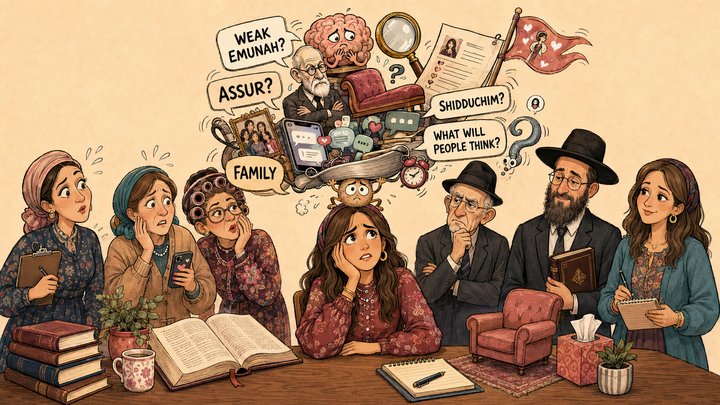
People quietly ask this question. They ask it at night or in a hushed conversation with a friend, fearful that seeking professional assistance with their mental health will demonstrate that their emunah is weak or that they are choosing psychology over Torah.
Therefore, the simple answer to this question is provided below, followed by the sources that support it. The majority of mainstream halachic authorities do not merely believe that therapy is permitted. Rather, they hold that caring for one's health (physical and mental) can become an obligation. The sources that support this position are outlined in this article. Please note that this article does not provide specific advice regarding your individual circumstances. If you have questions related to your specific situation, please consult your Rav.
The final sentence above serves as the context for everything that follows. This article will describe the sources that a Rav would use to answer your questions regarding therapy, so you can enter discussions with him/her with knowledge of the general landscape. However, it is not intended to provide a psak.
The Verse Upon Which All Questions Regarding Therapy Turn
To begin, let's look at where the Gemara begins. The Torah describes a situation where one individual causes harm to another and is required to pay for the injured party to receive treatment. The language used in describing this requirement is duplicated: "v'rapo yerapei" (Exodus 21:19), and shall surely heal. The Sages observed this duplication and concluded from it that permission is granted to the physician to heal. This conclusion is documented in the Gemara in Bava Kama 85a (on the passage of Rabbi Yishmael's school):
"From here we learn that permission is granted to the physician to heal."
Please read that again, as it contains far greater meaning than it appears to contain. At the time of the Gemara's creation, there existed a debate regarding whether doctors were permitted to treat patients suffering from illnesses sent by God, or whether doing so constituted interference with God's will. As stated earlier, Chazal concluded from the duplication of language in Exodus 21:19 that healing is not an act of defiance against God's will. Instead, healing is permitted. Some commentators explain that the reason for the duplication of language was to prevent people from assuming that only human-inflicted injuries could be treated, whereas illnesses caused by God were meant to be endured without intervention. Both forms of healing are acceptable.
From Permissibility to Obligation
While permissibility represents the minimum standard for healing, several areas of halacha support the notion that there is an obligation to protect the body that God provided. One area of halacha states that we are commanded to "v'nishmartem me'od l'nafshoseichem" (Deuteronomy 4:15), and you shall guard your souls, or your lives, very much. Poskim interpret this as a directive to take care of our health and not neglect it. Another area of halacha states that a person should live by the mitzvos ("v'chai bahem") (Leviticus 18:5), which is the basis for pikuach nefesh, the concept that saving a life takes precedence over almost every other aspect of Torah. The Rambam writes in Hilchos Deos that maintaining a healthy body is part of serving God, because a sick person cannot properly learn and serve Him.
Together, these two areas of halacha paint a clearer picture. The Rambam writes that a sick person is obligated to find a physician. The Rashba and later the Birkei Yosef write clearly that one cannot simply sit back and wait for a miracle; a person who rejects medical treatment and waits for a divine cure has committed an error, not an act of piety. The Rambam compares curing the sick to turning wheat into bread. Both are commonplace acts performed by humans that God wants us to perform.
Is the Mind Included?
Here is where an honest reader pushes back. Okay, a broken leg, an infection, a fever. Those are all related to the body. But a therapist treating something- would that be considered refuah by the Torah? This is the underlying question beneath the surface question, and it deserves an honest answer instead of a catchy phrase.
The classical sources did not use the word "therapy," but they certainly addressed the inner life. The Rambam provides a striking example of this. In his Shemoneh Perakim, he compares a doctor who treats the body to a healer who treats the middos and soul, recognizing emotional/character-related illness as something genuine that can be diagnosed and treated rather than as a moral flaw that can be scolded away. The concept of mental suffering as a legitimate illness that requires expert attention rather than judgment is an ancient one.
Most contemporary poskim have extended the logic of "v'rapo yerapei" from physical medicine to psychological care, considering depression, anxiety, trauma, etc., as health conditions subject to the same permission/obligation to seek help. Clinical therapy is a relatively modern invention compared to the Gemara. Principles are not.
The Rabbi Who Was Also a Psychiatrist
No single individual closed the perceived gap between Yiddishkeit and mental health care more than Rabbi Dr. Abraham J. Twerski (z'l), who passed away in 2021. He was a Chassidic Rav from a distinguished Rebbishe family and simultaneously a practicing psychiatrist who established Gateway Rehabilitation Center and authored more than sixty books. He was one of the first Chassidim born and raised to pursue medical education at a time when doing so was rare.
His entire life served as an argument (primarily unspoken) that there is no contradiction between deep frumkeit and receiving genuine assistance with one's mind. He founded Nefesh International (an organization comprised of Orthodox mental health professionals representing various levels of observance), and he spent decades publicly stating that emotional illness is indeed illness. As tributes following his passing indicated, he saw no contradiction between his Orthodox faith and his work as a scientist/healer. Many frum families received permission through his very existence that hundreds of lectures could not provide.
Why Does It Still Feel Forbidden?
If the sources supporting therapy are so clear, why do many people still quietly fear that therapy is somehow untznius with their Yiddishkeit? The hesitation stems from sociology rather than halacha. It stems from stigma, and stigma has its own history. Part of it originated in the early twentieth century when psychology appeared with Freud's face — openly dismissive of religion — and some rabbinical authorities from that era advised people against pursuing a field that seemed antagonistic towards belief. This association persisted long after psychology developed beyond Freud. Part of it stems from typical community dynamics where fears are not whether something is assur but what others will think, what effect it will have on shidduchim, will this affect my family? These are legitimate concerns. However, these concerns do not reflect whether Torah permits therapy. Confusing these two aspects causes people suffering who have every halachic right to improve their condition.
The One Thing Your Rav Can Do
General permission is not the same as specific guidance for your particular situation. This is where a live Rav makes a difference that an article cannot. Most forms of therapy do not create any halachic issues whatsoever. Occasionally, a particular situation creates halachic issues, and those situations warrant bringing before a posek rather than attempting to guess at them. Examples include treatment plans affecting Shabbos or medication schedules; therapists whose advice appears to conflict with your values; questions concerning a particular modality; or questions regarding medications themselves. A Rav who understands mental health — preferably working collaboratively with clinicians rather than in opposition to them — is precisely the right person to consult concerning these types of issues.
What a Rav is generally not doing is determining whether you are allowed to want help. The sources have addressed this previously. Choosing a therapist who understands your world is essential for doing this correctly. This is why many frum individuals specifically seek out therapists who share/genuinely understand their background, so no session is spent explaining what a Yom Tov is or defending why it matters.
Where to Start
If you have been avoiding considering therapy for some time now and awaiting someone to tell you it's okay, please consider yourself told, along with the supporting evidence for it. Seeking assistance with your mind does not constitute retreating from Torah. Rather, according to mainstream views, it represents part of fulfilling the commandment in Torah to protect the life that Hashem has provided for you. When you are prepared to do so, OKclarity's directory of frum/Jewish therapists lists professionals who understand your world. Additionally, OKclarity's Match Me tool assists you in refining your search criteria when you are uncertain about where to begin your search process. For specific questions related to halacha/treatment plans regarding your personal situation, please consult your Rav. For generalized questions regarding whether Judaism permits therapy at all, Torah provided an answer many years ago.
Glossary of Terms for Less Familiar Readers
- Assur: prohibited under halacha
- Avodas Hashem: service of Hashem; the work involved in leading a religious life
- Bava Kama: a tractate of the Talmud that primarily addresses damages
- Chassidishe/chassidim: relating to Chassidism; adherents of Chassidism
- Chazal: the Sages of the Talmud, collectively
- Emunah: faith in Hashem
- Frum/frumkeit: observant/religious; observance
- Gemara: discussion/analysis within Talmud
- Halacha: Jewish law
- Hashem: God; literally "the Name"
- Middos: character traits
- Mitzvos: commandments
- Pasken/psak: ruling on a halachic question; halachic ruling
- Petirah: death/passing away
- Pikuach nefesh: saving a life; overriding almost all aspects of Torah
- Posek/poskim: rabbinic authority ruling on halacha
- Rav: rabbi; typically a person's individual halachic authority
- Rebbishe: relating to a Chassidic rebbe's family/court
- Refuah: healing/medical cure
- Shaila: question posed to a Rav concerning halacha
- Shidduchim: matches for marriage; frum dating/matchmaking system
- Shemoneh Perakim: Rambam's "Eight Chapters," introduction to Pirkei Avos relating to soul/character
- Tznius/untznius: modesty; used here loosely as appropriate/inappropriate
- Yiddishkeit: Jewishness/Jewish religious life
- Yom tov: Jewish holiday
References
- Talmud Bavli, Bava Kama 85a (on Shemos 21:19), "v'rapo yerapei," derivation that permission is granted to physician to heal
- Rambam (Maimonides), Mishneh Torah, Hilchos Deos (on guarding health as part of serving Hashem); Shemoneh Perakim (on healing soul/character)
- Devarim 4:15 ("v'nishmartem me'od l'nafshoseichem"); pikuach nefesh from "v'chai bahem" (Vayikra 18:5)
- Rashba & Birkei Yosef (on obligation to seek medical treatment/prohibition against relying solely upon miracles in place of treatment)
- Biographical information concerning Rabbi Dr. Abraham J. Twerski & Nefesh International. Jew in the City Tribute (2021). https://jewinthecity.com/2021/02/a-tribute-to-rabbi-dr-abraham-twerski-ztzl/
Written for general education purposes as an overview of Torah sources & mainstream halachic views. It is neither a psak halacha nor medical advice. For guidance regarding your personal situation, please consult your Rav & licensed professional.
Comments (0)
Add Comment
Login to join the discussion