
Grief That Doesn't Stick to the Calendar: Complicated and Delayed Mourning
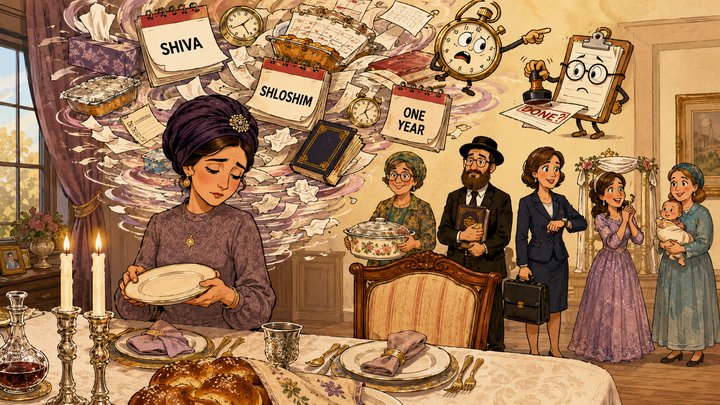
Two years after her mother's passing, she continues to set a seat at the Shabbos table out of habit. However, once she realizes what she has done, she quietly takes the plate away before anyone sees it. The shiva ended. The shloshim ended. The Kaddish for a year ended. Everyone else around her appears to have incorporated their loss into everyday life, but she has not been able to do so. This article addresses those frum men and women whose grief has extended beyond the time frame established by the calendar, as well as the family members who are witnessing someone they care about remain emotionally paralyzed long after the rest of the community has moved on. The article also addresses individuals whose grief did not manifest itself until many years after a loss they believed they had accepted.
The following will provide a simpler explanation of the topic. Most grief, regardless of how severe it is, will eventually lessen in intensity over time. A smaller number of cases do not experience this reduction in intensity. When the intense feelings of yearning and preoccupation with the deceased person persist at their highest level for a period exceeding approximately twelve months, and these feelings start to prevent an individual from functioning in everyday life, clinicians refer to this phenomenon as prolonged grief disorder. The American Psychiatric Association recognized this condition in the DSM-5-TR in 2022. Prolonged grief disorder is not a sign of weakness, nor is it a reflection of an individual's lack of emunah. Prolonged grief disorder is a diagnosable condition that can be treated.
The Aveilus Calendar Is a Blessing, and At Times a Curse
Judaism does not require mourners to develop their own methods for dealing with grief. Judaism provides a structured framework for dealing with grief, and this structure is exceptionally intelligent. Aninus protects you prior to the burial, when you are not expected to perform any functions or even to daven. Shiva forces you to sit for seven days, and brings members of the community to visit you. Shloshim releases some of the constraints placed upon you for thirty days. For a parent, aveilus and Kaddish will last for nearly a full year, and yahrzeit and Yizkor will continually remind you of your loss throughout your lifetime.
Millions of people benefit from the structure provided by aveilus during the most difficult weeks of their lives. Aveilus gives grief a place to go. Unfortunately, a structure has an expiration date, and grief does not always abide by it. After the formal aveilus period has concluded and the casseroles have ceased arriving, and the minyan no longer inquires about your well-being, you may feel privately that the structure provided by aveilus suggested a deadline for completing your grieving process, and failing to meet that deadline implies that there is something wrong with you. Nothing is wrong with you. The halachic timeline establishes when the community should respond to a death. It has never predicted how long each individual heart would need to heal.
What "Complicated Grief" Actually Means
Grief and prolonged grief are not two distinct emotional states. Both are forms of grief that occur at varying intervals. Normal grief consists of waves that gradually decrease in frequency. You begin laughing again. The deceased person becomes a comforting presence rather than an open wound, even though you still miss them. Prolonged grief occurs when normal grief does not transition into this type of resolution. Prolonged grief occurs when a year or more has passed since the loss occurred and the yearning remains as strong as it was during the first week.
Clinically speaking, there are specific characteristics associated with prolonged grief disorder. These characteristics are based on the criteria outlined in the DSM-5-TR. The death occurred at least one year ago. You experience intense yearning for the deceased person or nearly constant preoccupation with them on most days. Additionally, you experience multiple clusters of the following: a perception that a part of you died as well; disbelief that they are gone; avoidance of reminders; severe emotional pain; difficulty returning to participation in everyday life; emotional numbness; a belief that life has lost its purpose; and profound loneliness. If you experience enough of these symptoms for a sufficient duration that they negatively impact your ability to engage in daily activities, then your grief moves from being considered normal to being classified as complicated.
How Common Is It?
Studies utilizing the new criteria indicate that prolonged grief disorder affects approximately five to seven percent of individuals who have experienced bereavement. The prevalence increases significantly based on how the deceased person passed away. Studies examining numerous studies of sudden, violent or traumatic deaths (i.e., suicides, accidents, etc.) indicated that nearly half of those who had experienced such losses experienced prolonged grief. Therefore, how the deceased person passed away influences your likelihood of developing prolonged grief disorder. A parent who lived until ninety years old and a child killed in a car accident create entirely different degrees of grief, and Judaism's single timeline for responding to grief minimizes this difference in a manner consistent with reality.
Delayed Grief
Delayed grief is grief that manifests itself later than expected and causes more confusion for people than complicated grief does. Someone buries a parent and gets through shiva in a composed state, says all the appropriate things, supports their family, and finds themselves unexpectedly relieved by how well they are doing. Eighteen months later, a grandchild is born; or they reach the age their father was when he died; or an ordinary Tuesday presents them with a smell or niggun; and everything arrives at once as if it had been waiting in another room. They panic because the timing makes no sense to them. However, clinically speaking, it makes sense. Grief that gets postponed (because an individual is too busy surviving or supporting others to allow themselves to feel it), does not simply go away. It waits.
Yahrzeit is a frequent catalyst for delayed grief, which is part of why the mesorah established a yearly marker. Similarly, semachos can also be catalysts for delayed grief. Standing beneath the chuppah of a child whom the deceased never met can cause an individual's previously completed grief to re-open. This is not regression; this is the grief finally finding an outlet.
When to Stop Waiting Out Grief
Frum families are patient people, and patience is generally beneficial when grieving. Most often, giving more time, more Tehillim, and more presence is the best course of action. So how do you differentiate between ordinary long-term grief and the type of grief requiring professional intervention? Several indicators are more important than calendars.
- Functionality does not return. Not sadness at semachos (which is normal), but months of being unable to work, manage a household or care for children.
- The intensity does not decrease. Week one and month fourteen feel identical with no softening between waves.
- Avoidance has narrowed your life. Rooms, food items, songs or entire yomim tovim are off limits because reminders are too painful.
- You desire not to be here or believe that continuing to live is disloyal to the deceased person.
If your grief includes suicidal ideation, then you must seek help immediately from either a rav, a professional or a crisis hotline regardless of whether you have waited long enough.
It is important to caution you regarding our world specifically. Within a community valuing emotional composure where mourners are initially supported and then suddenly abandoned after shloshim, it is easy for someone experiencing severe grief to appear as though they are coping. They dress appropriately; attend services; respond "baruch Hashem" when asked how they are doing. However, composing oneself does not equal healing; and often those who support others most effectively are those whose own grief goes unrecognized for extended periods of time.
Treatment for Complicated Grief and Its Differences from Traditional Talk Therapy
Grief therapy is not intended to assist you in "getting over" a parent or spouse or God forbid a child. No qualified clinician will attempt to diminish the significance of your loss or dissuade you from missing your loved one. This fear deters many frum individuals from seeking assistance in an environment that could benefit them greatly; therefore it is essential to emphasize this point. The objective of treating complicated grief is to enable your yearning and pain to move again so that love for your loved one can exist independently from his/her absence consuming everything else.
There are evidence-based techniques specifically developed for prolonged grief differing significantly from generalized talk therapy; and clinicians specializing in bereavement will be knowledgeable about these techniques. Additionally, a skilled frum-aware clinician will comprehend the previously discussed framework of aveilus; thus enabling a mourner to avoid having to explain what yahrzeit is or justify why he/she continues crying during Yizkor services. Therapy and Yiddishkeit are not mutually exclusive; indeed, Chazal structured mourning with significant psychological insight; transitioning an individual through various stages from internal raw grief towards external gradual grief. Modern grief work operates similarly.
Many individuals also fear that requiring assistance indicates their faith has failed; however faith and a grieving nervous system reside in distinct realms. Numerous deeply religious individuals possess unwavering faith; however many cannot escape grief that has physically altered their sleep patterns, appetites and focus. Faith does not serve as an alternative to care any more than it serves as an alternative to receiving treatment for a broken bone.
Where Can a Frum Family Begin?
If someone you know is unable to regain footing twelve months after experiencing loss, or if delayed grief has caused them to lose their footing, the next step is not another chizuk sermon; it is discussing this issue with someone trained in this field. OKclarity's directory of therapists providing bereavement/grief counseling within Jewish communities exists for this exact purpose; furthermore, OKclarity's larger directory of frum/Jewish therapists can assist you if you are struggling with issues indirectly connected to grief as well. Grief is not an issue to be resolved by the end of shloshim; it is a manifestation of love that has lost its direction and deserves similar care as you would provide to any other wound that has failed to heal on its own.
Glossary for Readers Unfamiliar with Hebrew/Yiddish Terms Used Above
- Aninus: Time frame between death and burial; during this time frame mourners are exempt from performing most mitzvos in order to focus on attending funerals.
- Aveilus: Mourning; halachic status and requirements associated with aveilus after death.
- Baruch Hashem: "Thank God"; common response given when asked how one is doing.
- Chizuk: Encouragement/strengthening
- Chuppah: Wedding canopy; by extension wedding ceremony itself
- Emunah: Faith/belief in God
- Kaddish: Mourner's prayer; recited for parents for eleven months and on yahrzeit
- Mesorah: Tradition passed down through generations
- Niggun: Tune/melody (often wordless)
- Petirah: Passing away/death
- Rachmana Litzlan: "May Merciful One protect us"; recited after referring to something terrible
- Semachos: Joyous events/ceremonies (weddings/bar mitzvahs etc.)
- Shiva: Seven-day mourning period following burial
- Shloshim: Thirty-day mourning period following burial
- Tehillim: Psalms; recited during times of distress
- Yahrzeit: Anniversary of death based on Hebrew calendar
- Yizkor: Memorial prayer recited on specific yomim tovim
- Yomim Tovim: Jewish holidays
References
- American Psychiatric Association. Prolonged Grief Disorder added to Diagnostic and Statistical Manual of Mental Disorders Fifth Edition Text Revision (DSM-5-TR), 2022.
- Prevalence of prolonged grief disorder using DSM-5-TR and ICD-11 criteria. Frontiers in Psychiatry, 2024. https://www.frontiersin.org/journals/psychiatry/articles/10.3389/fpsyt.2024.1266132/full
- Pooled prevalence of prolonged grief after violent and traumatic loss. Frontiers in Psychiatry, 2022. https://www.frontiersin.org/journals/psychiatry/articles/10.3389/fpsyt.2022.880380/full
This article is intended solely for educational purposes and should not be used as medical advice. Complicated and delayed grief can be treated; however only licensed professionals can determine appropriate treatment plans for each individual situation.
Comments (0)
Add Comment
Login to join the discussion