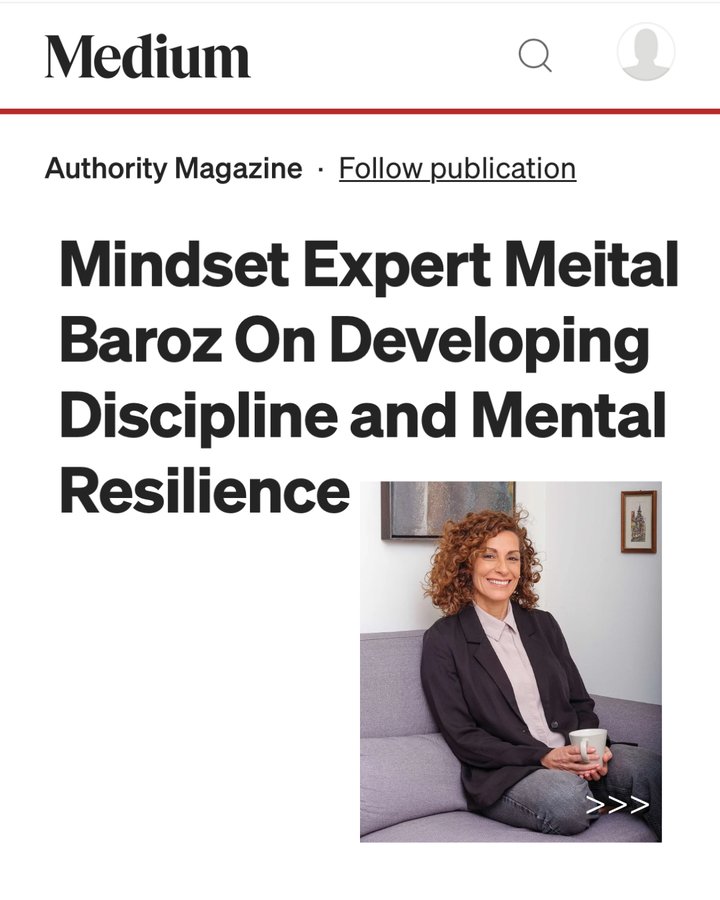
🔗 link to the interview: https://medium.com/authority-magazine/mindset-expert-meital-baroz-on-developing-discipline-and-mental-resilience-238a395268bd
Or you can simply read it here:
***
Discipline and mental resilience are key factors in achieving personal and professional success. Yet, many people struggle with staying consistent, overcoming setbacks, and maintaining a strong mindset in the face of challenges. What strategies can help individuals develop greater self-discipline and mental toughness? What habits and mindset shifts make the biggest impact?
As a part of this series, we had the pleasure of interviewing Meital Baroz.
Meital Baroz has a framework developed through her work with high-achieving individuals who are trying to overcome what makes them feel upset. Realizing that despite motivation, willpower, and even awareness, we oftentimes feel held back by internal overwhelm, she helps clients deal with the internal settings and release the hidden limitations to optimize the sense of possibility, energize growth, and achieve greater success. As a certified hypnotherapist and neuroscience coach, she integrates advanced tools to reveal the rooted setbacks and facilitate flow of thriving and leveling up.
Thank you so much for joining us in this interview series! Before we dive into the main focus of our interview, our readers would love to “get to know you” a bit better. Can you tell us a bit about your childhood backstory?
Sure, I’d love to; childhood backstory feels important in each life story, and I have an experience that keeps on defining me. I grew up in a warm family; while my physical needs were provided abundantly, emotionally I was extremely challenged. I grew up with a big birthmark on my face; big and dark, it faced me with the fact that I was different, and not in a good way. Growing up in the 70s, options in removing it could lead to a meaningful scar. In reality, I was never isolated, had close friends, and had wonderful experiences, but deep inside what was piling up was doubt, shame, and restlessness. It’s not a surprise I developed social anxiety along the way.
From a young age, I understood I had no way to hide the birthmark, on the other hand, I didn’t understand that suppressing the emotion was shaping the loop I got trapped in. In my early twenties, I was finally able to remove the birthmark. While the external change was immediate, I could really feel what the meaning of “rooted deep” is. I like to think of it as the ugly duckling syndrome; physically I became the swan but still couldn’t fly high. Only later in life could I change the perception, release the emotional charge, and truly start to soar. That’s when I realized: awareness and willpower aren’t enough to let go. You have to shift what’s running beneath the surface. I believe this pivoted my story and practice, redefining the internal settings to stop being weighed down and instead thrive, evolve, and level up.
What or who inspired you to pursue your career? We’d love to hear the story.
It was a realization, finding the missing part I didn’t even know I was looking for. And it completely changed my path.
This is actually my second career. For many years, I was an interior architect and got used to managing my patterns; overthinking was high, but I got used to it, while books, workshops, and lectures on the subconscious were part of my me-time. During one seminar, I got to know one of the main components of healing and self-growth, the crucial part we must address when we’re willing to create meaningful change.
Like many of us, I knew about the conscious and subconscious and how they oftentimes are misaligned, but I didn’t know about the part that sits in between, the gatekeeper that determines whether our conscious will and choice can actually reach what drives us from within. This gatekeeper explained everything: the doubt, the challenge, why we struggle to implement change despite motivation and willpower, why awareness alone isn’t enough, and why self-development so often fails.
I didn’t plan to change careers. With the realization that we usually push hard to change, while hypnosis naturally creates a state where we can gently bypass this resistance, I enrolled in a hypnotherapy college for a year, just out of curiosity. During my training, I was amazed at how easily the overthinking and childhood patterns simply dissolved. The more I deepened my knowledge, the greater my urge to share with others. I started offering pro bono sessions alongside my design work; after a little over 200 sessions and what people achieved, there was no doubt, it felt like a life calling. My last design project was in 2019. Over the years, I expanded my education with more neuroscience tools that allow the identification of this layer and better understanding of how it operates in each person. I see the mind as a structure, and this gatekeeper is the part I focus on, the game changer.
It has been said that our mistakes can be our greatest teachers. Can you share a story about the funniest mistake you made when you were first starting? Can you tell us what lesson you learned from that?
As a young hypnotherapist, I used to watch YouTube content for inspiration and thought I had to lead the hypnosis part in a dramatic and mysterious tone. Thinking about it now is funny, pretty fast I stopped; it definitely didn’t feel right.
The lesson? Once we bypass the gatekeeper and can communicate with the subconscious, it’s a unique window of time. Words and suggestions matter deeply, but not in the generic, one-size-fits-all way you see online. The key is customization, tailoring everything to that specific person’s mind structure. The entire idea is to create a natural flow that feels comfortable to the subconscious, so it doesn’t trigger resistance again.
The more natural it feels, the more effective it is. I record and email the hypnosis session to each client after we meet. Thinking back to those first few weeks and listening to those recordings now? Absolutely hilarious.
Let’s talk about our main topic, developing discipline and mental resilience. What’s one common misconception people have about discipline or mental resilience, and how do you reframe it for your clients?
When we struggle with discipline or resilience, it’s usually not because we lack capability. The challenge is related to the structure of the mind.
Here’s what I mean: when you have a desire or goal, it comes from your conscious mind, which is significantly smaller compared to the subconscious. The difficulty stems from misalignment: The subconscious holds different data based on what you’ve done so far, while the conscious mind is now trying to do more or apply a change. The system first rejects it, consistency is the way to show it is important. You won’t give up. The thing is, usually when we face this resistance, we start to doubt ourselves, hesitate, or procrastinate, and the inconsistency reinforces itself.
Usually when I ask, “Why do you think you are doing that?” the answer will be “I am not sure” or “Now that I see it this way, it makes a lot of sense.” That’s because the subconscious is debating your conscious goal, new habit, or will.
And the misconception? We’ve gotten used to thinking that change should be long and hard, that we need more willpower. But here’s the paradox: while the system is actually designed for growth, expansion, and evolution, effort actually works against it. When this natural design meets pushing and forcing loaded with frustration and self-sabotage, setbacks are created instead of flow.
If something doesn’t work, there’s always a reason why, we talk about the human brain and mind, so powerful and smart. It’s like a bug in your operating system, you have to address it first. If your internal system is still operating on old patterns or is overloaded, no amount of willpower will override that. I like to think of discipline or resilience as a reflection of this alignment between the structure’s parts.
I always educate my clients and explain “behind the scenes” so they can have awareness of the subconscious part as well. Once we redefine their internal settings and they understand how their system works and why, discipline becomes something different. Bottom line, they have to take responsibility, proving to themselves they’re capable rebuilds resilience, and being able to operate from the conscious part means less effort and more success.
Can you walk us through a real-life example (your own or a client’s) where mindset shifts made the difference between quitting and persevering?
Of course, I like that you are asking to walk through it, as our life has a timeline; the mindset defines if we walk and progress along time or get stuck. Quitting is like doing more of the same, while resetting the mind is what facilitates the shift, allowing us to move forward.
I respect my clients’ confidentiality and can talk only to those who shared themselves about their experience. One good example is a client from NY. She is a lifestyle coach and Reiki master who reached out to me in 2022. Worried and frustrated, she developed imposter syndrome, doing much while not feeling or reaching success.
I feel my work involves self-understanding; first, understand each client’s story and how they operate, then map this with their structure: we can better track the subconscious trends. Finding out whether you are right- or left-brain dominant provides many insights. Nowadays we even have the ability to characterize and define how the resistance layer operates. Putting all of these together leads to a huge “ahh” moment.
With her, I remember she was so surprised, I could objectively see that she was already a success; her mind was so foggy she couldn’t see or feel that.
Once we changed the old perceptions and cleared the accumulated overload, pretty quickly she could set the mind, shift, and boost the energy that allows not just to persevere but to thrive and expand. We can be much more creative and productive this way.
How do you recommend building mental resilience in environments that are chaotic, high-pressure, or emotionally draining?
I believe the first important thing is to pay attention to the signals your system is sending. Noticing them allows you to map out and adjust decisions. It’s always helpful to focus on what is within your control, especially when external pressure is high and it feels chaotic. Ask yourself, “What in my routine or choices can I adjust to ease the load, even temporarily?”
When we feel this way, these sensations often indicate an overload, whether it’s from the present or from the past, daily habits are especially important when mental and emotional energy are low. For example, your sugar intake, not in matters of weight, but the unnecessary emotional swings it creates on top of those you might already feel. This could include overstimulation, like scrolling or multitasking all at once. A useful mental image is to imagine how your system is perceiving the information and what you can do to help out. During these times, we need to reduce by prioritizing things around, think of your internal system, and what can you do to help it out?
Overthinking, overstimulation, overload, and feeling overwhelmed, the “over” in all of them indicate it might be too much. If the environment is challenging, look for the things you can soften or improve within yourself. By noticing, mapping, and adjusting, you can better manage the energy and mental resilience.
In your experience, is discipline more about eliminating distractions or building new habits, and how can someone find the right balance?
From what I see, avoiding distractions and building new habits are not separate efforts. They support each other because we’re always working with an internal system that operates through inputs and outputs. What comes in, what stays, and what we allow to leave all shapes how the system functions.
When outdated perceptions about growth or unresolved emotional load from the past are no longer influencing present choices, balance begins to form naturally. That balance shows up as clarity and flow within the system. Even when challenges are present, resilience stays solid, and we don’t lose the center we’ve built.
This system works in cycles and repetition. The real work is reshaping the current loop into one that holds clarity, joy, and flow. Balance isn’t something abstract, it’s felt as a quiet mind, ease in action, and a sense of enjoyment in doing.
Here is our main question. What Are “5 Things You Need to Know to Develop Discipline and Mental Resilience”?
A few things I feel are important to keep in mind:
1. We Have A Reward System
Actions that create imbalance or pressure trigger one response, cortisol. Actions that bring satisfaction trigger another, serotonin, dopamine. I like to think of it like a game of life. The more consistency and small wins you build, the more resilience develops, and you level up.
2. Our Mind Is Flexible. Give It Time
When you want to improve or change a pattern or habit, at first you’ll face resistance. But with discipline and consistency, you create a new neural pathway. Over time, the old one fades and the new one becomes your way of being. It’s important to know this is a process. We tend to lose patience, but it’s worth letting it work.
3. Mind First Or Body First. Both Are Valid Paths
Some of us are more left-brain dominant, others more right-brain. This affects how we engage change. For some, the mind leads, a thought or decision moves them into action. For others, the body is the gateway, movement comes first, and the mind follows. When building resilience and discipline, it’s important to notice what works better for you. Are you more mind-body or body-mind? Sometimes a clear thought is all you need to get moving. Other times, when the mind feels stuck or foggy, starting with the body, taking a walk, changing your posture, moving, can reactivate momentum and bring clarity back.
4. Discipline Without Compassion Leads To Burnout
You can force discipline through pressure, but only for a short time. When the inner dialogue is harsh or unforgiving, the system stays in survival mode, and consistency becomes exhausting. Compassion creates internal safety, and safety is what allows discipline to last. When we relate to ourselves with respect rather than constant criticism, we keep our energy, stay balanced, and build resilience over time.
5. Everything In Our System Works In Cycles
Action reinforces progress, and progress reinforces belief. Thinking, planning, or wanting change is not enough on its own. The subconscious doesn’t argue with facts, it responds to experience. When you take action, even small actions, you create evidence. Over time, those actions reshape the loop, and what started as conscious effort becomes embodied and natural. And don’t forget to breathe and smile. That counts too.
What’s a simple yet underrated daily practice that helps strengthen mental resilience over time?
One daily practice that is extremely crucial for mental and emotional stability takes place at night. The subconscious does most of its work during sleep and dreaming. During the day, the system is busy taking in information and handling familiar pressures. At night, the real internal processing happens. Quality sleep is when the mind integrates, clears, and updates. These hours are crucial.
To benefit even more, pay attention to the time before falling asleep, the natural hypnotic state you go through. We tend to bother ourselves with thoughts at this time. But when you wind down and let yourself enter that natural state, you allow the process of resilience to happen.
Sleep quality often reflects stability. High achievers frequently work on this, training themselves to improve their sleep. It’s a practice worth prioritizing.
Ok, we are nearly done. You are a person of great influence. If you could inspire a movement that would bring the most amount of good for the greatest number of people, what would that be? You never know what your idea can trigger.
If I could inspire a movement, it would be one that prepares people in their early 20s, right after college or before entering it, for adulthood. This is the transition between adolescence and young adulthood, when patterns either set or shift.
Much of what we carry is generational. Clearing it early creates real space for growth. I work mostly with people in their 30s to 60s, and I see how these patterns become ingrained. Imagine if internal preparation became a natural part of growing up, like a foundational program that allows them to rise higher in life.
We are very blessed that some of the biggest names in Business, VC funding, Sports, and Entertainment read this column. Is there a person in the world, or in the US, whom you would love to have a private breakfast or lunch with, and why? He or she might just see this, especially if we both tag them :-)
It would be with Dr. Joe Dispenza. In 2013, when I moved to the U.S., the popular edition of his book “Breaking the Habit of Being Yourself” was released. Reading it, I was immediately drawn to how he takes abstract concepts like thoughts and emotions and presents the structure of them. I went to his retreat and learned a lot from his workshops. What’s more, when I attended the seminar at the hypnotherapy college I told you about, I learned he had graduated there, which felt like a confirmation that I was on the right path. I find his work with the subconscious deeply inspiring, and he’s been a great teacher and an inspiration to me.
Thank you for these really excellent insights, and we greatly appreciate the time you spent with this. We wish you continued success.
Thank you so much for having me. I hope this conversation helps someone recognize what’s possible when we work with the system, not against it.
_______________________________________________________________
Meital Baroz C.Ht | Certified Clinical Hypnotherapist & Neuroscience Coach.
Helping English and Hebrew speakers release deep subconscious patterns, childhood and generational trauma, emotional blocks, anxiety, procrastination, low self-confidence, and feeling stuck. Meital works with a wide range of clients, including high-achieving professionals and entrepreneurs seeking to reduce mental overload, restore focus, energy, and drive, as well as individuals navigating personal growth, relationship challenges, emotional trauma, and recovery from past experiences.
The Up↑Set Method™ is designed to take you from feeling upset to truly set up for the life you want. If any of this resonates with you, reach out to explore how these approaches, separately or combined, can create the shift you’ve been looking for.
Book a free call here:
https://calendly.com/baroz-social/strategy-call-with-meital-baroz-lp