
What is Religious OCD (Scrupulosity)? A Frum Guide
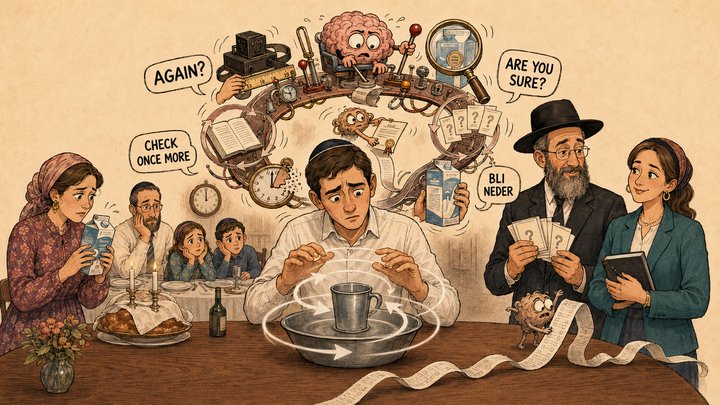
She washes negel vasser a fourth time because she lost track of her counts around the second. He cannot leave shul until the last word of Shemoneh Esrei comes out exactly right, so he davens it again and then once more after that. On the surface both appear to be people who take Yiddishkeit seriously. However, internally they feel afraid. This guide is for frum families who may believe that their family members' care for halacha has turned sour and are looking to learn about religious OCD prior to deciding on their course of action.
This is the simple version. Religious OCD is referred to in the medical world as scrupulosity. Scrupulosity is a type of obsessive compulsive disorder in which the obsessions and compulsions attach themselves to religion and morality. An individual will experience intrusive fears regarding sinning, punishment, or incorrect performance of mitzvos. The individual will attempt to relieve these fears through repetitive actions, checking, or questioning. The content is Jewish; the mechanism underneath is OCD.
This One Distinction Carries the Whole Article
This one distinction carries the entire article, and it is crucial to think about this before moving forward with anything else because nearly all of the mistakes families make regarding scrupulosity arise from reversing this distinction. Washing negel vasser multiple times, davening Shemoneh Esrei multiple times, and continuously asking shailos to the rav are not the disease itself. They are what the disease compels an individual to do in order to temporarily feel secure.
This Is Not a Story About Being "Too Frum"
It is easy to view scrupulosity as religion gone overboard and as if the solution is simply to be less concerned with religion. However, this reverses the cause. Religion does not cause OCD. As Jed Siev writes for the International OCD Foundation, OCD is opportunistic and attaches itself to whatever an individual values most. Therefore, an observant Jew with OCD experiences religious symptoms instead of symptoms related to germs or locks. Remove the frumkeit and the same brain would focus elsewhere. Additionally, OCD is common. According to the National Institute of Mental Health, approximately 2.3% of U.S. adults will develop OCD at some point in their lives, which means roughly one out of every forty U.S. adults will experience OCD. In a community containing thousands of families, OCD is not uncommon. Instead, there are dozens of individuals attending shul each week believing that they are the only individual experiencing the feeling of the walls closing in on them.
How OCD Borrows the Clothes of a Mitzvah
Due to the fact that Judaism relies heavily on precise and repetitive actions, scrupulosity has numerous avenues to utilize. The International OCD Foundation lists several categories in which frum symptoms typically manifest themselves and most families will recognize at least one of these categories:
- Kashrus: One speck of milk appears to have contaminated the meat. One crumb of chametz appears to have survived the Pesach cleaning process that required several weeks to complete.
- Shabbos Carrying and Sorting: Repeatedly checking and sorting items on Shabbos.
- Taharas Hamishpacha: Continually counting and preparing for mikvah beyond what was recommended by the rav.
- Davening: Reciting the same words over until the kavanah feels right. Moving tefillin a millimeter and then again.
- Hedging every sentence with "Bli Neder".
- Asking the same shaila multiple times using slightly different wording in hopes of obtaining a clearer answer.
Although none of these examples represents OCD on their own, a careful individual checks a hechsher and continues eating. The differentiator is in the execution rather than the deed.
Furthermore, it is beneficial to define what scrupulosity is not. A chumra voluntarily undertaken by an individual with a rational mind is completely unrelated to scrupulosity. Many frum individuals voluntarily undertake a stringency due to their love for Hashem and calmly maintain it. This type of action is avodah and belongs solely to the individual performing it. Conversely, scrupulosity is a stringency that an individual did not voluntarily undertake and is unable to remove from their life.
Three Questions That Distinguish a Mitzvah from a Compulsion
This is likely the portion of this article that competing resources fail to provide for frum readers. Siev provides three questions that assist in distinguishing between a mitzvah and a compulsion.
First Question: What do others do? Community standards provide a loose measure. If your rav, parents, and all functional members of your minyan wash once and proceed with eating and you are on your fifth round of washing negel vasser, then the additional rounds warrant further consideration.
Second Question: What is actually causing the behavior? The same behavior can be avodas Hashem or a compulsion depending upon why it occurs. Washing hands to be clean and prepared for davening is a mitzvah. Washing hands to alleviate an overwhelming feeling of dread is a compulsion disguised as a mitzvah. The distinguishing factor is anxiety because genuine observance is not driven by panic.
Third Question: Is it destroying your life? For most individuals Yiddishkeit provides stability and reduces stress. When religious practice begins consuming hours of an individual's day, disrupts Shabbos meals, causes an individual to be tardy or ashamed or prevents an individual from functioning normally then this is not indicative of increased piety. This indicates that something has gone awry.
Note What These Questions Do Not Require
You do not need to become less frum in order to answer these questions honestly.
What the Torah Built In Long Before Anyone Said "OCD"
This is generally surprising to individuals and is arguably the most optimistic aspect of this article. Halacha is not a requirement for perpetual certainty. Chazal developed numerous mechanisms specifically designed so that Jews would not have to reside in the exact loop that OCD desires.
Trace amounts of prohibited substances are nullified (bitul) and you are not obligated to pursue them. You can rely on the majority (rov) rather than anticipate the worst-case scenario at all times. Doubt within doubt (sfek sfeika)? You are allowed to disregard it. There is even a specific term for the exact engine of OCD (the dread that something you previously checked has changed since you last viewed it): ein l'davar sof - there would be no end to it - therefore, you cease checking it.
Additionally, the Gemara states explicitly that Hashem did not deliver the Torah to angels. Perfection was never intended as the benchmark. Above all lies a verse that poskim frequently cite - "Her ways are pleasant ways and all her paths are peace."
The clearest example of this concept comes from Rabbi Yaakov Yisrael Kanievsky (the Steipler), one of the most highly regarded halachic authorities of the past century. In a passage translated by Greenberg & Shefler (and cited by the International OCD Foundation), Rabbi Kanievsky defines the boundary himself:
"The person who whenever he fulfills Hashem's will experiences discomfort, fear, tension and misery while fulfilling a commandment; conversely, he generally experiences discomfort, fear, tension and misery while fulfilling Hashem's will; furthermore, he rarely experiences joy while fulfilling Hashem's will - this clearly demonstrates that Hashem did not desire this type of experience."
If you have been convincing yourself that experiencing misery is a necessary component of fulfilling Hashem's will seriously - read that quote again. A Gadol is stating in writing that it is not.
The Reassurance Trap
This is typically where well-intentioned and compassionate families create additional problems without intending to do so. Reassurance fuels OCD in much the same manner that oxygen fuels fire. When a bochur asks his mother for the tenth time if the milk was indeed pareve and his mother responds patiently for the tenth time - the apprehension momentarily subsides before returning with greater intensity than previously experienced. The act of seeking reassurance was reinforced - therefore it continues seeking reassurance - thereby tightening the loop.
A similar situation occurs with a rav. An individual with scrupulosity will bring the same shaila back to a rav in multiple variations - each variant is treated as a new inquiry by a patient rav who unwittingly feeds the very entity that is causing pain to his talmid. Thus - some poskim who comprehend OCD will kindly refrain from responding to further inquiries regarding shailos pertaining to scrupulosity and refer the individual seeking assistance to a therapist. This is not indicative of indifference - rather it is a more compassionate response.
For families - the ironic aspect of providing a healthy response is that it appears as if you are acting heartlessly. You cease providing answers - cease checking blechs for them - cease confirming that their hands were washed properly - cease repeating "you're fine - you're fine." Not with indignation - not immediately cold turkey - but as part of a strategy developed in consultation with a clinician who specializes in treating scrupulosity/OCD. Taking away reassurance allows the fear to finally diminish.
What Actually Helps
Exposure & Response Prevention (ERP), a specific form of cognitive-behavioral therapy often referred to simply as ERP - is the primary treatment modality for OCD (including scrupulosity). Put simply - an individual learns to tolerate the fear of having performed something incorrectly without engaging in a compulsive behavior that typically follows - thereby allowing the fear to gradually lose its influence over them. When implemented correctly - ERP for scrupulosity is not related to faith whatsoever - it merely enables an individual to rid themselves of OCD so that they may once again perform mitzvos freely.
The most obvious concern - and valid concern - is whether undergoing treatment will cause an individual to violate halacha. When implemented correctly with an appropriate clinician - ERP for scrupulosity does not encourage violation of halacha - but rather enables an individual to confront uncertainty that OCD fears while remaining within permissible boundaries. When genuine halachic questions arise - both the clinician and a trusted posek collaborate together rather than oppose each other. No one should be compelled to choose between their Yiddishkeit and their mental well-being - this choice is fallacious.
Medication may be necessary for some individuals - however not all individuals require medication for treatment of OCD/scrupulosity. Standard medical options for moderate to severe OCD include selective serotonin reuptake inhibitors (SSRIs) - the same medications used for treating depression - generally at higher dosages and administered for longer periods of time before taking effect. SSRIs do not replace ERP - many individuals improve without using SSRIs - however an individual whose obsessions are too intense for therapy alone may benefit from SSRIs - which enable them to reduce their obsessions sufficiently so that they may participate effectively in therapy sessions. This decision should be made in collaboration with a psychiatrist knowledgeable about OCD - OKclarity lists frum psychiatrists specializing in prescribing medication for OCD/scrupulosity along with its list of frum/Jewish therapists.
We intentionally kept this section brief - how ERP operates step-by-step - how it addresses brachos - netilas yadayim - intrusive thoughts specifically - is beyond the scope of this article - however, we plan to address it in depth in future articles.
Where a Frum Family Can Begin
If any of this resembles someone in your household - do not resolve to take on a greater chumra or firmly resolve to cease compulsive behaviors - but rather contact a professional knowledgeable about both OCD/scrupulosity and the environment in which these symptoms exist - OKclarity's directory of therapists specializing in treating OCD/scrupulosity in Jewish communities was developed for precisely this purpose - as well as OKclarity's broader directory of frum/Jewish therapists - if you are unsure where to begin - OKclarity's Match Me tool assists you in narrowing down your options.
Ultimately - the objective was never to eliminate Yiddishkeit from anyone - but rather enable them to experience Yiddishkeit without anxiety.
Plain-English Glossary
For Readers Less Familiar With Hebrew/Yiddish Terms Above:
- Avodas Hashem (avodah): Service of Hashem; activities associated with Jewish religious life.
- Bitul: Principle within halacha stating that minute quantities of forbidden substances are disregarded/nullified - thus you are not obligated to search for them.
- Blech: Metal plate placed over stovetops enabling food to remain warm throughout Shabbos.
- Bli neder: "Without a vow" - added to declarations of intent so that they are not considered vows requiring fulfillment.
- Bochur: Young man - typically a yeshiva student.
- Brachos: Blessings recited before/after consuming food - etc.
- Chametz: Leavened food prohibited during Pesach.
- Chazal: Sages of Talmud collectively.
- Chumra: Stringency voluntarily accepted by an individual going above/beyond requirements imposed by halacha.
- Davening: Praying/prayers.
- Ein l'davar sof: "There would be no end to this" - principle indicating that you do not continue checking something indefinitely.
- Frum/frumkeit: Religiously observant/observance.
- Gadol: Respected rabbinic authority regarding Torah matters.
- Gemara: Talmudic discussions/laws.
- Halacha: Jewish law/traditions.
- Hashem: God/literally "the Name".
- Hechsher: Kosher certification.
- Kashrus: Laws governing kashrus/keeping kosher.
- Kavanah: Intention/focus during prayer/etc.
- Mikvah: Ritual bath used for purification purposes.
- Mitzvah (plural mitzvos): Commandments/obligations/good deeds imposed by Judaism.
- Negel vasser: Ritual washing of hands upon waking.
- Netilas yadayim: Ritual washing of hands prior to consuming bread/etc.
- Pareve: Foods containing neither meat nor dairy ingredients.
- Pesach: Passover.
- Posek (plural poskim): Rabbi authorized to render decisions regarding Jewish law/traditions.
- Rav: Rabbi - generally an individual's personal halachic authority.
- Shabbos: Sabbath.
- Shaila (plural shailos): Inquiry directed towards a rav concerning Jewish law/traditions.
- Sfek sfeika: "Doubt within doubt" - leniency allowing compounded uncertainty to permit certain actions/items/etc.
- Shemoneh Esrei: Central standing prayer recited three times daily.
- Steipler (Rabbi Yaakov Yisrael Kanievsky): Prominent halachic authority who lived from 1899-1985.
- Taharas hamishpacha: Laws pertaining to family purity - including niddah/mikvah.
- Talmid: Student.
- Tefillin: Boxes containing scriptural passages worn during weekday morning prayers.
- Yiddishkeit: Jewishness/Jewish religious life/practices.
References
- Siev, J. "Jewish Scrupulosity." International OCD Foundation website. Updated September 2024. Accessed via: https://iocdf.org/faith-ocd/living-with-ocd-religious-traditions/jewish-scrupulosity/
- International OCD Foundation website. "What Is OCD & Scrupulosity?" Accessed via: https://iocdf.org/faith-ocd/what-is-ocd-scrupulosity/
- National Institute of Mental Health website. "Obsessive-Compulsive Disorder (OCD)" statistics. Accessed via: https://www.nimh.nih.gov/health/statistics/obsessive-compulsive-disorder-ocd
- Steipler (Rabbi Yaakov Yisrael Kanievsky) passage - Grinwald 1991 - translated/quoted by Greenberg & Shefler (2008) via International OCD Foundation website article titled "Jewish Scrupulosity" (Siev).
This article was written for general educational purposes and should not be considered medical advice - scrupulosity/OCD are treatable conditions and licensed professionals can assess individual cases.
Comments (0)
Add Comment
Login to join the discussion