
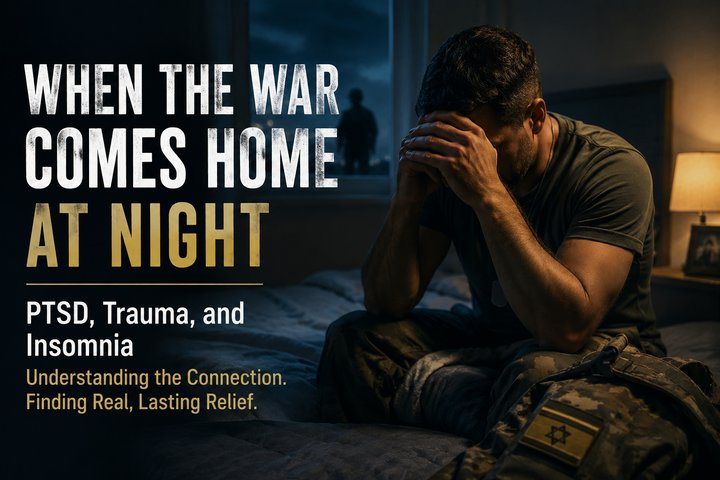
A while ago, I worked with an Israeli soldier who had served in combat in Lebanon.
During the day, he looked strong and capable. He could speak clearly, function normally, take care of responsibilities, and move through life the way people expected him to. From the outside, you might never have known what was happening inside.
But at night, everything changed.
His body was exhausted, but his mind would not shut off. He would lie in bed tense and alert, listening to every sound, feeling like some part of him was still waiting for danger. Sometimes he would finally fall asleep, only to wake suddenly with his heart racing, as if the battlefield had followed him into the bedroom.
That is one of the most painful things about trauma. The event can be over. The person can be home. The danger can be gone. But the body may still be living as if it needs to protect itself.
For many people struggling with PTSD, trauma, chronic stress, or deeply painful life experiences, insomnia is not just a “sleep problem.” It is not simply poor sleep hygiene, too much caffeine, or a bad bedtime routine. Those things can play a role, but they are often not the real root.
Sometimes the real issue is that the nervous system has learned to stay on guard.
And sleep requires the opposite.
Why Trauma Makes Sleep Feel Unsafe
Sleep is one of the most vulnerable things we do.
In order to fall asleep, the brain has to lower its guard. The muscles have to soften. The breathing has to slow. The mind has to stop scanning and allow consciousness to fade. For someone whose body feels safe, this can happen naturally. The day ends, the lights go off, and the body begins to settle.
But trauma can change the way the body experiences safety.
When someone has lived through combat, abuse, loss, a frightening medical experience, a serious accident, or any event that overwhelmed their ability to cope, the nervous system may become trained to stay alert. It learns that danger can come suddenly. It learns that being relaxed may not be safe. It learns to watch, listen, brace, and prepare.
That response can be very useful during an actual emergency. The problem is that after trauma, the alarm system can stay turned on long after the danger has passed.
This is why someone can be lying in a quiet bedroom, in a safe home, with no real threat around them, and still feel tense inside. Their mind may know, “I’m safe now,” but the body does not always believe it. The body may still be listening for footsteps, scanning the silence, waiting for the next shock.
This state is often called hyperarousal. It means the nervous system is activated, alert, and ready to respond. In real life, it can feel like being exhausted and wired at the same time. The person desperately wants to sleep, but the body is acting as if sleep would be dangerous.
This is why generic sleep advice can feel so frustrating for people with trauma-related insomnia. Telling someone to turn off screens, drink tea, meditate, or keep the room cool may help a little, but it often misses the deeper issue. The problem is not always that the person does not know how to relax. The problem is that some part of the body does not feel safe enough to relax.
And when the body does not feel safe, sleep becomes very difficult.
How PTSD and Insomnia Feed Each Other
PTSD and insomnia often create a painful cycle.
Trauma makes it harder to sleep, and poor sleep makes trauma symptoms harder to manage. After a bad night, the brain has less emotional strength. The person may feel more anxious, irritable, sensitive, overwhelmed, or easily triggered. Thoughts can become darker and harder to control. The body may feel more reactive. Small stresses that might have been manageable after a good night can feel enormous after several nights of broken sleep.
Then nighttime comes again, and the person is already depleted.
This is where insomnia becomes more than a symptom. It becomes part of the trauma loop.
The bed may begin to feel like a place of pressure instead of rest. The person starts wondering, “Will I sleep tonight? Will I wake up again? Will I have another nightmare? How will I function tomorrow if this happens again?” These thoughts are understandable, but they keep the brain in a state of threat. The more pressure there is around sleep, the harder sleep becomes.
For people with PTSD, nightmares can make this even more complicated. A person may begin to fear sleep itself because sleep is where the memories return. Even if the nightmare is not an exact replay of what happened, it can carry the same emotional charge: fear, helplessness, panic, shame, grief, or the feeling of being trapped.
Over time, the person may start avoiding sleep without even realizing it. They stay up late, keep lights on, scroll on their phone, eat, work, or distract themselves because being awake feels safer than entering the unknown world of sleep. But the less they sleep, the more exhausted and emotionally vulnerable they become.
This is the cruel cycle of trauma-related insomnia. The body needs sleep to heal, but the trauma response makes sleep feel unsafe. Then the lack of sleep keeps the nervous system even more sensitive.
It is not weakness. It is not laziness. It is not a lack of discipline.
It is a survival system that has not yet learned that the danger is over.
Why an Integrative Approach Goes Deeper
When someone comes to me with insomnia connected to trauma, stress, or PTSD, I am not only interested in how many hours they slept last night. I want to understand the full picture.
What happens in their body when they get into bed? What thoughts begin to show up? What emotions are they trying not to feel? What does nighttime represent to them? Are they afraid of nightmares? Do they feel safer staying awake? Is their breathing shallow? Is their body tense? Are there physical imbalances making the nervous system more reactive? Has their sleep become tangled with years of frustration, medication, fear, or disappointment?
This is where an integrative approach becomes so important.
There are excellent tools in the sleep world. CBT-I, for example, can be very effective for insomnia. It helps people rebuild healthier sleep patterns and change the behaviors and thoughts that keep insomnia going. But when trauma is involved, even good tools need to be used with sensitivity. If someone already feels pressured, ashamed, or out of control, a rigid sleep plan can sometimes make them feel even more trapped.
The goal is not to force the body into sleep.
The goal is to help the body feel safe enough to sleep again.
That may include practical sleep strategies, but it also has to include nervous system regulation. It may involve working with the fear around sleep, calming the body’s alarm response, changing the subconscious associations connected to the bed and nighttime, and helping the person stop relating to sleep as a nightly test they have to pass.
For some people, the work is deeply emotional. Their insomnia is connected to grief, fear, anger, or memories that were never fully processed. For others, the body is carrying the stress physically through muscle tension, shallow breathing, blood sugar instability, hormonal disruption, inflammation, or years of running on adrenaline. Many people have both emotional and physical layers happening at the same time.
That is why one-size-fits-all sleep advice so often fails.
Two people can both say, “I can’t sleep,” but the reason may be completely different. One person may need help reducing sleep anxiety. Another may need trauma-informed support. Another may need to rebuild circadian rhythm. Another may need to calm an overactive stress response. Another may need to address the physical health patterns that are keeping the body wired at night.
The symptom is insomnia.
But the root is personal.
A real sleep plan has to respect that.
Helping the Body Feel Safe Enough to Sleep Again
The soldier I worked with did not simply need a better bedtime routine.
He needed his body to learn that the battlefield was no longer in his bedroom.
That kind of healing does not come from pushing, judging, or forcing. It comes from understanding. It comes from working with the nervous system instead of fighting it. It comes from helping the person slowly rebuild trust in their own body.
This is one of the most important shifts in healing insomnia: sleep is not something we can force. Sleep is something the body allows when the conditions are right.
That does not mean we do nothing. It means we do the right things in the right way. We create structure without pressure. We build consistency without rigidity. We address the mind without ignoring the body. We support the body without pretending the emotions do not matter. We help the person stop fearing the night and begin experiencing the bed as a place of safety again.
For many people, this is possible much sooner than they expect. Sometimes even one good session can give a person a new understanding of what is happening inside them. That alone can reduce fear. Instead of thinking, “My body is broken,” they begin to see, “My body has been trying to protect me.” That shift matters because fear of insomnia often becomes part of the insomnia itself.
When the body begins to feel safe, sleep can start to return more naturally. The breath slows. The muscles soften. The mind stops scanning as intensely. The person may still have work to do, but they are no longer fighting themselves every night.
And when sleep improves, life begins to open again.
People often think the goal is just more hours of sleep, but it is much bigger than that. Better sleep means more patience with your family, more clarity at work, more emotional strength, more resilience, more health, and more ability to feel like yourself again.
Trauma can make a person feel as if the past is still running their life. Insomnia can make them feel trapped inside their own body. But the nervous system can learn new patterns. The body can come out of survival mode. The bedroom can become peaceful again.
If you are struggling with insomnia, nightmares, PTSD, or a body that feels like it cannot shut down, there may be a real reason your sleep has become so difficult. And once we understand that reason, we can begin helping your mind and body heal in a way that is calm, respectful, and effective.
If you are ready to understand what is really driving your sleep issues, reach out to schedule a free sleep consultation.
Together, we can look at the full picture — your sleep, your stress, your nervous system, your health, and your story — and begin building a plan that helps your body feel safe enough to sleep again.
Comments (0)
Add Comment
Login to join the discussion